Today, we sit down with Marius Boboc, our Business Intelligence (BI) Consultant with over 23 years of experience in Business Intelligence and Data Warehouse projects. He shares the real challenges he’s encountered modernizing BI and Data Warehouse platforms for enterprise clients — and how he and his team overcame them.
BI & Data Warehouse Modernization: What It Really Takes
Most organizations don’t wake up one day and decide to modernize their Data Warehouse. They arrive at it gradually — reporting cycles that keep stretching, manual processes that keep piling up, and a BI platform that was built for a business half the size it is today.
The starting point: a platform that’s hit its ceiling
Across the Business Intelligence and Data Warehouse engagements we run for clients in banking, retail, and telecommunications, the pattern is remarkably consistent. Legacy platforms. Data sources scattered across systems that were never designed to talk to each other. Reporting processes that still depend on manual steps somewhere in the chain.
None of this is a failure on the client’s part — it’s what happens when data volumes and business demands grow faster than the platform underneath them. The result is longer reporting cycles, rising maintenance costs, and a growing gap between what the business needs to know and how quickly it can find out.
What modernization actually involves
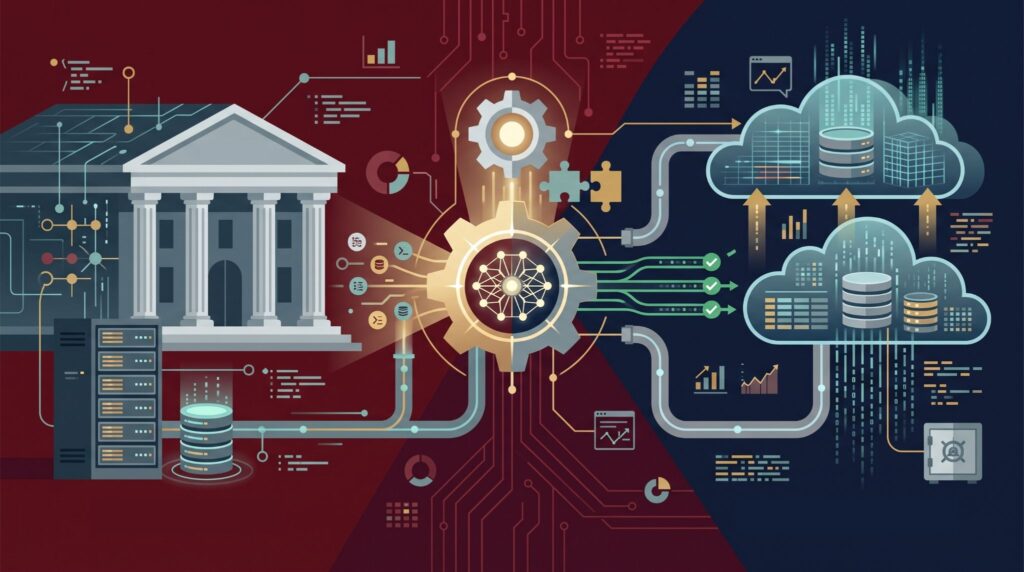
At IDS Consulting, we design and deliver end-to-end Business Intelligence and Data Warehouse solutions — not point fixes, but complete transformations built around business continuity.
That typically means:
Modernizing the legacy platform itself, re-architected for scale rather than patched around its original limits. Migrating existing ETL processes and reporting environments onto the new foundation, so the business logic behind years of reports doesn’t get lost in the move. Designing scalable analytics architecture built for where the business is headed, not just where it is today. Guiding the transition onto modern data platforms while keeping day-to-day reporting running throughout.
The hardest part: modernizing a system that can’t stop running
The single biggest challenge in this kind of work isn’t technical — or rather, it’s not only technical. It’s modernizing business-critical systems without disrupting the operations that depend on them every day. That means managing complex migrations, integrating dozens of data sources, handling large-scale data volumes, and designing architecture that balances business continuity against long-term modernization goals, all at once.
These aren’t quick engagements. Depending on scope, they run anywhere from several months to multi-year transformation programs, with IDS teams typically ranging from 5 to more than 20 consultants — Solution Architects, BI Consultants, Data Engineers, ETL Developers, and QA Engineers working alongside the client’s own data team.
I’ve spent the last 10 years sitting across the table from data teams in the middle of exactly this kind of transformation. And whatever the industry, the starting point rarely changes: a Data Warehouse that used to be enough, and isn’t anymore.
What I’ve learned over that decade is that the technology is rarely the hardest part. The hardest part is modernizing a system the business can’t afford to stop relying on, while it’s still running. Every migration, every new architecture, every automated process we introduce has to earn its place without breaking what the client already depends on.
Marius Boboc, Business Intelligence Consultant, IDS Consulting
What changes on the other side
Clients who complete this kind of modernization consistently report the same shifts: faster access to data they can actually trust, manual processes replaced by automation, reporting that performs better under load, and a platform built to support growth rather than strain under it. Decision-making speeds up. Operational effort and maintenance costs go down.
It’s not a single before-and-after moment — it’s a platform that keeps paying off as the business keeps growing.
Looking to modernize your Data Warehouse or BI platform? Talk to our team.
IDS Consulting — We always deliver. Expert Data Services.